
Cloud IoT Security: Zero Trust, Identity, and Signed Updates

On September 11, 2026, the Cyber Resilience Act’s incident-reporting rules start applying in the European Union. That is 22 days after this article’s publication date. A manufacturer that learns of an actively exploited vulnerability or a severe security incident in a connected product may need to send an early warning within 24 hours and a full notification within 72 hours.
Those deadlines expose a weakness in many cloud-based IoT systems: the team can collect millions of sensor readings, but it cannot answer a basic incident question quickly. Which physical device used this credential, what firmware was it running, which MQTT topics could it reach, and can we isolate it without taking the entire fleet offline?
Cloud IoT security starts there. Encryption matters, but TLS alone cannot distinguish a healthy device from a cloned device using a stolen certificate. Multi-factor authentication protects administrators, not unattended sensors. A firewall may shield an API while an over-permissive MQTT policy lets one compromised gateway publish commands for every device in the account.
This guide builds the complete control chain: a unique identity for every device, least-privilege messaging, protected keys, signed firmware, behavioral monitoring, evidence retention, and a quarantine path that operators have already tested. The AWS examples use IoT Core, IoT Device Defender, IoT Jobs, Amazon EventBridge, and CloudWatch, but the design applies to any serious IoT system.
Start with trust boundaries, not a product checklist
A cloud-based IoT ecosystem is more than a device talking to a message broker. It includes manufacturing, provisioning, local networks, gateways, cloud ingestion, storage, user applications, update infrastructure, support tools, and the people allowed to operate them.
That is why “encrypt everything” is not a security architecture. Encryption protects a channel. It does not prove that the software at either end is trustworthy, prevent an authorized device from publishing to the wrong topic, or give an operator a safe way to revoke access.
Map the system as a set of trust boundaries:
| Boundary | Asset at risk | Likely failure | Control that limits the blast radius |
|---|---|---|---|
| Device hardware | Private keys, firmware, calibration data | Key extraction or physical tampering | Secure element or TPM, secure boot, debug interface lockout |
| Provisioning line | Device identity and ownership | One bootstrap secret copied across a production batch | Per-device credentials, short-lived claim permissions, manufacturing audit trail |
| Local network or gateway | Commands and telemetry | Rogue gateway, replay, packet interception | Mutual TLS, message freshness, gateway isolation, local allowlists |
| Cloud message broker | Topic namespace and fleet control | Wildcard policy lets one device impersonate another | Client ID binding, topic-scoped authorization, explicit deny for quarantine |
| Application and API | User accounts, commands, fleet metadata | Account takeover or broken object authorization | MFA, workload identity, per-tenant authorization, rate limits |
| Data platform | Telemetry, location, health, and customer data | Cross-tenant access or unnecessary retention | Encryption, tenant boundaries, minimization, retention enforcement |
| Update service | Firmware and configuration | Malicious or failed update disables a fleet | Code signing, staged rollout, abort thresholds, rollback image |
| Operations plane | Logs, certificates, policies, response tools | Alert without ownership or evidence | Central findings, tested runbook, immutable audit records |
Write an abuse case for each row. If sensor-042 is stolen, can it publish only to devices/sensor-042/telemetry, or can it write to devices/+/commands? If the signing key is compromised, how do you rotate trust without visiting 50,000 installations? If a device has been offline for nine months, will it reject an expired server certificate because its clock drifted?
The hard part is rarely choosing a cloud service. It is preserving a trustworthy identity and a recoverable operating state through ten years of manufacturing changes, battery failures, network outages, certificate rotations, and ownership transfers.
Use standards as an engineering baseline
IoT guidance becomes useful when it turns into testable requirements. Four sources cover most of the baseline without forcing every product into the same design.
| Source | What it contributes | Evidence your team should keep |
|---|---|---|
| NIST IR 8259 Rev. 1 | Manufacturer activities before sale, updated in April 2026 | Risk model, expected customers, support assumptions, documented requirements |
| NISTIR 8259A | Device identification, configuration, data protection, interface control, software update, and security-state awareness | Product requirements and verification results for each capability |
| ETSI EN 303 645 V3.1.2 | Consumer IoT provisions such as no universal default passwords and a vulnerability-disclosure process | Conformance statement, update policy, disclosure contact, password design |
| NIST SP 800-207 | Zero Trust model: no implicit trust based on network location or ownership | Resource-level authorization rules and continuous access decisions |
| EU Cyber Resilience Act | Product cybersecurity and vulnerability-handling obligations for covered products in the EU | Product risk assessment, support period, vulnerability records, incident timeline |
These documents do not say that every temperature sensor needs the same controls as a medical pump. NIST describes a baseline, not a universal implementation. A battery-powered sensor may have tight memory and energy constraints. A gateway controlling industrial equipment may need deterministic offline behavior and a maintenance window that a consumer camera does not.
Document the exception instead of silently dropping the control. If a device cannot run an NTP client, state how it establishes trustworthy time before validating certificates. If it cannot support two firmware partitions, explain the recovery method after a failed update. A known limitation with an owner and compensating control is manageable. An undocumented limitation becomes an incident surprise.
The reference architecture: separate data, control, and security planes
The safest IoT architectures keep three paths distinct.
The data plane carries telemetry from devices to the broker and downstream services. The control plane manages registry entries, policies, certificates, thing groups, and deployments. The security plane observes both, detects abnormal behavior, and can restrict a device without granting the telemetry pipeline administrative power.
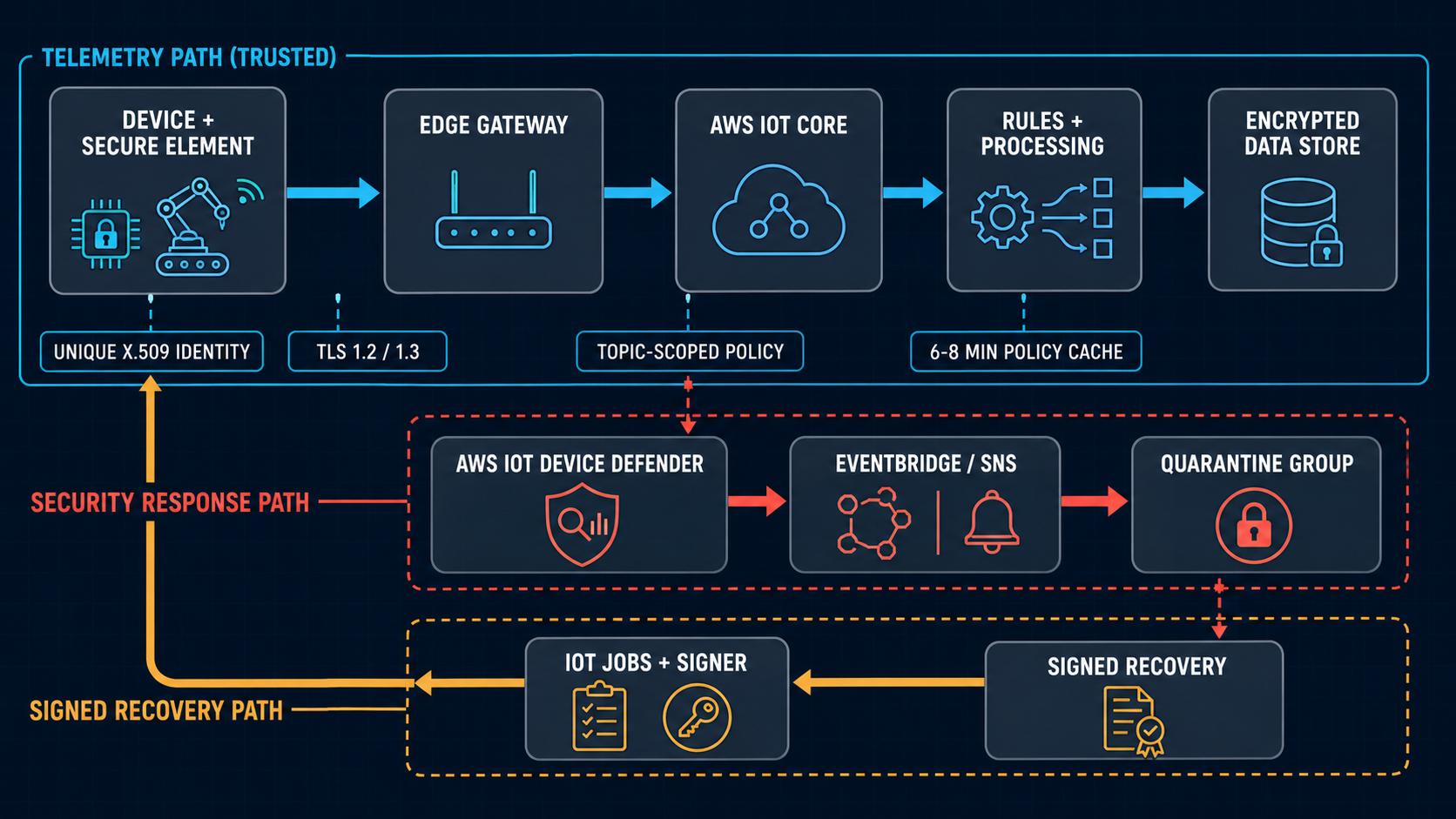
A practical AWS flow looks like this:
- A device boots verified firmware and loads its private key from protected hardware.
- It validates the AWS IoT Core server certificate, then completes mutual TLS with its own X.509 certificate.
- IoT Core binds the MQTT client ID to the thing identity and evaluates an IoT policy for each connect, publish, subscribe, and receive action.
- Rules send telemetry to processing services and encrypted storage. Devices never receive direct database credentials.
- IoT Device Defender audits certificate and policy configuration, then evaluates device and cloud metrics for abnormal behavior.
- EventBridge or SNS routes a finding to the response workflow. High-confidence cases can disconnect the client and place the thing in a quarantine group.
- IoT Jobs distributes a signed repair or firmware update in controlled waves. The device verifies the signature before installation.
This split matters. The Lambda function that processes temperature messages should not rotate certificates. A customer-facing API should not modify IoT policies directly. The remediation role should be able to quarantine a thing but not rewrite every production policy. The same least-privilege approach used in a solid AWS IAM roles and policies design belongs in the IoT control plane.
Give every device one identity
AWS recommends a unique identity principal for each device and warns against sharing certificates. That advice is not ceremonial. Shared credentials remove your ability to distinguish a compromised unit from the rest of its model line.
One certificate per device gives you four operational capabilities:
- Revoke one device without disabling the fleet.
- Bind authorization to the thing name and MQTT client ID.
- Attribute connections and policy violations to a specific unit.
- Rotate credentials in stages instead of coordinating one global cutover.
The private key should be created or injected in a secure element, TPM, or other protected storage and should not be exportable during normal operation. If contract manufacturing is involved, treat provisioning as a privileged production system. Record the hardware serial number, thing name, certificate ID, firmware build, manufacturing batch, and ownership state. Do not record the private key.
AWS IoT Core supports fleet provisioning and just-in-time provisioning for manufacturing at scale. A bootstrap or claim credential must have one narrow job: create the permanent device identity. It should not publish production telemetry, subscribe to command topics, or remain installed as the device’s daily credential.
For a lab device, the control-plane sequence is easy to see with the AWS CLI:
aws iot create-thing \
  --thing-name sensor-042

aws iot create-keys-and-certificate \
  --set-as-active \
  --certificate-pem-outfile sensor-042.crt \
  --public-key-outfile sensor-042.public.key \
  --private-key-outfile sensor-042.private.key \
  > sensor-042-certificate.json
That command writes a private key to disk, which is acceptable for a throwaway lab and a poor production manufacturing design. Generate the key inside protected hardware when the product supports it. At minimum, transfer it through an authenticated, logged provisioning station and remove temporary copies.
Also plan certificate rotation before launch. AWS IoT Core’s server-authentication guidance tells device developers to make root CA certificates updateable. A device with a hard-coded trust store and no secure update path may work for years, right up until a CA transition turns it into an expensive brick.
Enforce least privilege in the MQTT namespace
Authentication answers “which credential connected?” Authorization answers “what may it do?” Many IoT deployments get the first answer right and then attach a wildcard policy that defeats it.
The MQTT topic tree is an authorization boundary. Design it before application teams create ad hoc topics.
devices/{thingName}/telemetry
devices/{thingName}/state
devices/{thingName}/commands
devices/{thingName}/events
The device may publish telemetry and state. It may subscribe to and receive commands for its own thing name. It should not publish commands, read another device’s data, or subscribe to devices/#.
AWS IoT thing policy variables let one policy remain reusable while permissions resolve to the connected thing. The following example binds the client ID and topic resources to the registered thing name:
{
  "Version": "2012-10-17",
  "Statement": [
    {
      "Effect": "Allow",
      "Action": "iot:Connect",
      "Resource": "arn:aws:iot:us-east-1:123456789012:client/${iot:Connection.Thing.ThingName}",
      "Condition": {
        "Bool": {
          "iot:Connection.Thing.IsAttached": "true"
        }
      }
    },
    {
      "Effect": "Allow",
      "Action": "iot:Publish",
      "Resource": [
        "arn:aws:iot:us-east-1:123456789012:topic/devices/${iot:Connection.Thing.ThingName}/telemetry",
        "arn:aws:iot:us-east-1:123456789012:topic/devices/${iot:Connection.Thing.ThingName}/state"
      ]
    },
    {
      "Effect": "Allow",
      "Action": "iot:Subscribe",
      "Resource": "arn:aws:iot:us-east-1:123456789012:topicfilter/devices/${iot:Connection.Thing.ThingName}/commands"
    },
    {
      "Effect": "Allow",
      "Action": "iot:Receive",
      "Resource": "arn:aws:iot:us-east-1:123456789012:topic/devices/${iot:Connection.Thing.ThingName}/commands"
    }
  ]
}
The distinction between topic and topicfilter resources causes real deployment failures. iot:Publish and iot:Receive use topic ARNs. iot:Subscribe uses a topic-filter ARN. A policy can be syntactically valid and still break subscriptions if those resource types are mixed up.
There is another operational gotcha: AWS IoT Core policy changes can take six to eight minutes to become effective because the service caches policy documents. Do not promise an instant quarantine based only on a policy edit. For urgent containment, disconnect the MQTT client and deactivate the certificate or apply a previously attached explicit deny, then verify the session is gone.
Human and service access belongs on a separate path. Administrators use federated identity and MFA. Mobile users go through an authenticated API with per-tenant authorization. Backend workloads use IAM roles. The patterns in this Zero Trust API security guide apply to the human-facing edge, while device certificates and IoT policies protect the MQTT data plane.
Protect transport, stored data, and the data you never needed
AWS IoT Core requires TLS for device-gateway traffic and supports TLS 1.2 and TLS 1.3. Its default non-GovCloud policy currently supports both. That is a strong transport baseline, but the device still has work to do.
It must validate the server certificate and hostname. It needs a trustworthy clock because X.509 certificates have notBefore and notAfter validity periods. It needs a root CA update mechanism. And it should fail closed when validation fails instead of silently accepting any certificate so the product “keeps working.”
At rest, apply encryption and access controls at every destination, not only the first one. Telemetry often fans out from IoT Core to Lambda, Kinesis, DynamoDB, Timestream, OpenSearch, and S3. Each copy creates a new retention and authorization question. If sensitive device data lands in S3, Amazon Macie can help locate personal or sensitive fields, but classification is not permission. Bucket policies, KMS keys, network paths, and tenant-aware application authorization still control access.
Data minimization is cheaper than protecting unnecessary data forever. Do you need raw GPS coordinates every five seconds, or would a geofence event be enough? Does a smart-building sensor need a tenant’s name in its payload? Can the edge gateway aggregate values before upload? Fewer sensitive fields mean fewer breach consequences and lower messaging, storage, and analytics costs.
Do not put cloud service credentials on a device. Let it publish to IoT Core, then use an IoT rule and a service role to write to the downstream service. Operator secrets and integration credentials should have rotation and ownership; the same principles covered in this Secrets Manager rotation guide apply to the services around the fleet.
Make secure updates a product feature
Firmware that cannot be updated safely has an expiration date whether the product plan admits it or not. The update path must handle authenticity, staged rollout, power loss, rollback, and long-offline devices.
AWS IoT Jobs can target individual things or thing groups, track execution state, limit rollout rate, retry failures, and stop a deployment when abort criteria are reached. AWS recommends signing the code file; the device must verify that signature before installation.
A production update process should include these controls:
| Control | Why it exists | Failure test |
|---|---|---|
| Signed manifest and firmware | Rejects modified or unauthorized code | Change one byte and confirm installation stops |
| Versioned artifact storage | Makes the exact deployed binary recoverable | Retrieve the hash and binary for an older release |
| A/B partition or recovery image | Survives power loss and bad boot | Cut power during installation and verify recovery |
| Anti-rollback rule | Prevents forced downgrade to a vulnerable build | Attempt to install a validly signed older version |
| Canary thing group | Limits the first blast radius | Inject a failure and confirm wider rollout never starts |
| Rollout and abort thresholds | Stops fleet-wide failure automatically | Exceed the error threshold in a staging fleet |
| Health confirmation | Distinguishes download success from working firmware | Fail the post-boot check and verify rollback |
| Offline-device policy | Handles units that miss several releases | Reconnect an old build and verify the supported upgrade path |
Signing solves authenticity, not quality. A correctly signed firmware image can still contain a memory leak that drains batteries or a driver change that breaks one hardware revision. Tie device groups to model, hardware revision, region, and current firmware. Canary each meaningful combination.
The release pipeline should generate an SBOM, vulnerability results, firmware hash, signature metadata, test evidence, approval record, and rollout configuration. Keep those records together. The supply-chain controls in this SBOM and signing workflow translate well to embedded builds even when the final artifact is not a container.
Detect behavior that certificates cannot prevent
A valid certificate only proves possession of a key. A stolen key is still valid until the platform revokes it. A device running compromised firmware may authenticate correctly and then behave very differently.
AWS IoT Device Defender has two complementary jobs. Audit checks configuration such as shared certificates, expiring certificates, permissive IoT policies, and disabled logging. Detect evaluates device-side and cloud-side metrics against rules or machine-learning models.
Useful behaviors include:
- Authorization failures above the normal baseline.
- Message volume or message size changes.
- Connections from unexpected IP ranges or countries.
- A device opening new listening TCP ports.
- A device communicating with a previously unseen destination.
- Repeated reconnects or conflicting MQTT client IDs.
- Firmware version drift from the approved fleet baseline.
Start with rules for conditions you can explain. A refrigeration sensor sending two measurements per minute does not need a machine-learning model to detect 2,000 publishes in five minutes. Rules are cheaper, easier to test, and easier to defend during an incident review. Add ML Detect where device behavior legitimately varies and static thresholds create too much noise.
Route alarms into an operating pipeline. Device Defender can publish to SNS and supports mitigation actions. EventBridge can invoke a response function or automation. Security Hub and CloudWatch can centralize the broader AWS evidence; this findings pipeline design shows how to keep alerts from becoming dashboard wallpaper. GuardDuty adds threat detection for the surrounding AWS accounts, workloads, and data paths, but it does not replace device-specific behavior monitoring.
AI can help group similar anomalies, summarize a burst of findings, and rank devices for investigation. It should not automatically brick a fleet based on an unexplained score. Require a high-confidence rule or human approval for destructive action, preserve the raw evidence, and test false positives against seasonal and maintenance behavior.
Build quarantine before you need it
Quarantine is not “delete the thing.” The goal is to stop harmful activity while keeping a controlled recovery path and preserving evidence.
An AWS pattern uses a static quarantine thing group with a policy that explicitly denies normal telemetry and command topics. Explicit deny matters because IoT policy evaluation is additive: an allow attached to the certificate remains effective unless a deny overrides it.
{
  "Version": "2012-10-17",
  "Statement": [
    {
      "Effect": "Deny",
      "Action": [
        "iot:Publish",
        "iot:Subscribe",
        "iot:Receive"
      ],
      "Resource": [
        "arn:aws:iot:us-east-1:123456789012:topic/devices/*",
        "arn:aws:iot:us-east-1:123456789012:topicfilter/devices/*"
      ]
    }
  ]
}
Keep the remediation channel separate and tightly scoped. Depending on the product, that may mean allowing only AWS IoT Jobs topics, a dedicated recovery endpoint, or no network recovery at all until a technician is present.
A response runbook can follow this order:
- Record the finding ID, thing name, certificate ID, client ID, IP address, firmware version, timestamps, and recent topic activity.
- Confirm that the signal is not a planned test, manufacturing process, or network migration.
- Add the thing to the quarantine group and disconnect the current MQTT session with
aws iot-data delete-connection --client-id sensor-042. - Deactivate a confirmed-compromised certificate. Preserve its metadata and the decision record.
- Search for the same certificate, firmware hash, destination IP, or behavior across the fleet.
- Deliver a signed recovery update or replace the device. Issue a new identity only after trust is re-established.
- Remove quarantine deliberately, verify expected behavior, and monitor the device at a tighter threshold for a defined period.
- Update the product risk model, detection logic, and customer or regulatory reporting timeline.
Do not discover during the incident that the quarantine group has reached a membership limit, the response role lacks iot:DeleteConnection, or the device needs the same denied topic to receive its repair. Run this exercise in staging, then repeat it after policy, firmware, or architecture changes.
Understand the cost and quota traps
Security controls add cost, but guesswork makes them look more expensive than they are. AWS publishes enough information to model the base path.
| Item | Published AWS example or rule | Design implication |
|---|---|---|
| IoT Core connectivity | In US East (N. Virginia), a continuously connected device is shown at about $0.042 per year | Connection time is usually not the dominant cost |
| IoT Core messages | Payloads can be up to 128 KB and are metered in 5 KB increments | An 8 KB publish counts as two messages before deliveries and rules |
| Device Defender Audit | Pricing example uses $0.0011 per active device principal per month | Creating and using replacement certificates in one month can increase active-principal count |
| Device Defender Rules Detect | Example rate is $0.025 per 100,000 metric data points | Pick metrics and reporting intervals intentionally |
| Device Defender ML Detect | Example starts at $2.00 per 100,000 data points for the first tier shown | ML on every metric can cost far more than rules |
| Policy propagation | IoT policy changes may take 6 to 8 minutes to become effective | Disconnect or deactivate for urgent containment |
These are examples from the AWS IoT Core pricing page and IoT Device Defender pricing page, not a quote for every Region. Check the current regional rates before approving a design.
Message shape deserves attention. One device publishing a 2 KB reading every minute produces 43,200 publishes in a 30-day month. At 100,000 devices, that is 4.32 billion inbound publishes before broker deliveries, rules, shadows, or downstream services. If the payload grows from 5 KB to 6 KB, AWS meters it as two messages rather than one. Batching may cut cost, but it increases the amount of data lost when one message fails and may add latency.
The cheapest secure design is usually selective. Report a few high-value Device Defender metrics at an interval that matches the risk. Use rule-based detection for deterministic limits. Reserve ML for devices whose normal behavior cannot be expressed cleanly. Store raw high-volume telemetry only as long as the use case requires.
Cloud-managed IoT is not always the right answer
A managed IoT broker removes infrastructure work, not product responsibility. Use it when you need fleet identity, device shadows, topic authorization, rules, and managed integrations at a scale where operating the broker yourself would distract the team.
| Situation | Recommended direction | Main tradeoff |
|---|---|---|
| Large public fleet with intermittent networks | Managed IoT platform with per-device certificates and store-and-forward behavior | Vendor integration and recurring messaging cost |
| Industrial site that must operate during cloud loss | Edge gateway with local control, cloud synchronization, and isolated safety functions | More software lifecycle work at the edge |
| Small internal deployment on one trusted site | Managed broker or carefully operated private MQTT cluster | Self-hosting may look cheaper until patching and HA are counted |
| Regulated product with long support life | Platform plus documented device lifecycle, signed updates, and evidence retention | Compliance remains the manufacturer’s job |
| Safety-critical real-time control loop | Keep deterministic control local; send supervision and analytics to the cloud | Cloud cannot be in the immediate safety path |
If you are still comparing providers, the existing AWS, Azure, Google, IBM, and Cisco IoT platform comparison is a useful starting point. Then validate the current service roadmap, regional availability, certificate model, update system, export path, and support lifecycle. A generic cloud security software catalog can help identify adjacent products, but a feature matrix cannot replace your threat model or proof-of-concept tests.
Network design still matters around the managed service. Private subnets, service endpoints, egress controls, and centralized inspection reduce the paths available after a cloud workload is compromised. This AWS VPC design patterns guide covers the account and subnet layouts that support that separation.
Compliance needs evidence, not a security adjective
The Cyber Resilience Act applies broadly to covered products with digital elements placed on the EU market, but scope and obligations depend on the product and economic operator. Its main requirements apply from December 11, 2027. Article 14 reporting applies from September 11, 2026, including to covered products already placed on the market. The European Commission’s reporting guidance describes a 24-hour early warning, a 72-hour notification, and later final-report deadlines.
That clock changes the operating design. You need a named team that can determine whether a vulnerability is actively exploited, reconstruct the first known activity, identify affected product versions, preserve evidence, and coordinate technical, legal, privacy, customer, and regulatory work.
Build an evidence set for every release and incident:
- Product risk assessment and threat model.
- Supported versions, hardware revisions, regions, and support period.
- SBOM and known-vulnerability review.
- Security test results and unresolved exceptions.
- Firmware hashes, signatures, signer identity, and approvals.
- Rollout targets, timestamps, failure rates, and abort decisions.
- Certificate issuance, rotation, revocation, and ownership records.
- Findings, raw logs, containment actions, and decision timestamps.
- Customer notice and vulnerability-disclosure records.
Talk with qualified counsel about legal scope and reporting decisions. The engineering team’s job is to make accurate answers possible within hours, not to invent the legal conclusion during an outage.
A 90-day implementation plan
Do not start by buying another dashboard. Fix identity and authorization first; they set the maximum blast radius of every later failure.
| Window | Engineering work | Exit test |
|---|---|---|
| Days 1-15 | Inventory devices, owners, firmware, credentials, topics, data stores, and update paths; draw trust boundaries | Every production device maps to an owner, identity, firmware version, and data path |
| Days 16-30 | Remove shared credentials and universal defaults; define topic taxonomy; bind client ID to thing identity | One device cannot connect or publish as another device |
| Days 31-45 | Protect keys, enforce TLS validation, minimize payloads, review cloud roles and tenant boundaries | Stolen application credentials cannot administer IoT resources; TLS failure is safe |
| Days 46-60 | Build signed updates, canary groups, abort rules, recovery, and certificate rotation | A corrupted update and a power-loss test both recover safely |
| Days 61-75 | Enable Device Defender Audit and selected Detect metrics; centralize logs and findings | Simulated anomalies create an owned ticket with evidence |
| Days 76-90 | Build quarantine, disconnect, revoke, recover, and reporting runbooks; run a tabletop exercise | Team isolates one test device without affecting healthy devices and reconstructs the timeline |
Track outcomes, not tool deployment. Good metrics include percentage of devices with unique credentials, percentage on supported firmware, median time to quarantine, certificate rotation success rate, update failure rate by hardware revision, and percentage of high-severity findings with a completed owner action.
The single most important test is simple: compromise one staging device on purpose. Try to publish to another device’s topic, reuse its client ID, install an unsigned build, send abnormal traffic, and reconnect after quarantine. The architecture is credible only when each control produces the expected failure and the response team can explain what happened.
What to remember
Cloud IoT security is a lifecycle, but that phrase should not become an excuse for vague work. Give every device one protected identity. Bind permissions to that identity. Sign and stage every update. Watch behavior after authentication. Keep a tested path to disconnect, quarantine, repair, and revoke one device without sacrificing the fleet.
TLS protects the connection. The rest of the design determines whether you can still trust what is connected.
Sources and further reading
- NIST IR 8259 Rev. 1: Foundational Cybersecurity Activities for IoT Product Manufacturers
- NISTIR 8259A: IoT Device Cybersecurity Capability Core Baseline
- NIST SP 800-207: Zero Trust Architecture
- ETSI EN 303 645 V3.1.2: Consumer IoT cybersecurity baseline
- Regulation (EU) 2024/2847: Cyber Resilience Act
- AWS IoT Core security best practices
- AWS IoT Core transport security
- AWS IoT Device Defender documentation
- AWS IoT Jobs firmware update guidance
- AWS Well-Architected IoT Lens security design principles
Explore more like this

Kill the Docker Hub Token: OIDC Trust for GitHub Actions
On July 31, 2026, Docker shipped OIDC connections for GitHub Actions to any organization on a Docker Team, Docker Business, or Docker Hardened Images subscription, plus organizations in the Docker-Sponsored...

Bedrock Web Search: Grounding an Agent Without Building a Scraper
On August 4, 2026, AWS made Web Search on Amazon Bedrock generally available, and the entire integration surface is one JSON object: {"type": "web_search"}. That is the whole change from...

ECR Now Allows 200 GB Image Layers. Your Model Weights Still Do Not Belong There
On August 3, 2026, AWS raised the maximum Amazon ECR image layer size to 200 GB for images pushed with docker push. The announcement names the driver in the second...

Comments