
CloudFormation Pre-Deployment Validation: Safer CDK and Stack Operations

CloudFormation now runs pre-deployment validation automatically on every CreateStack and UpdateStack operation, not only while creating change sets. A malformed property or resource-name collision can fail before AWS provisions or modifies anything. CDK users can call the same service-backed checks with cdk validate and get source tracing back to the construct that produced the template.
AWS also added warning checks for service quotas, AWS Config recorder conflicts, and ECR repository deletion readiness, plus a DisableValidation escape hatch for an individual operation. These changes reduce a painful class of failures that appear several minutes into deployment and leave a stack rolling back.
Pre-deployment validation is not a proof that a stack will succeed. It checks known failure patterns, needs read permissions for some account state, and adds a few seconds to operations. Runtime service behavior, custom resources, organization policies, asynchronous stabilization, and application readiness still exist.
This guide shows how to layer CloudFormation validation with cfn-lint, CDK synthesis, change sets, policy-as-code, integration tests, and production gates. It also explains when WARN findings should become CI failures and why disabling validation should be a time-bounded exception.
If your team is beginning with CDK, use the TypeScript CDK introduction for constructs, synthesis, and deployment concepts before adding this pipeline.
Understand FAIL and WARN modes
CloudFormation divides validation outcomes into two modes:
| Mode | Current checks | Stack behavior |
|---|---|---|
| FAIL | Property syntax, required/unsupported values, resource-name conflicts | Stops create/update before provisioning; change set becomes failed |
| WARN | Service quotas, Config recorder conflict, S3 bucket emptiness, ECR delete readiness | Reports finding while an eligible change set can proceed |
FAIL mode protects the operation automatically. WARN mode provides information; your pipeline decides whether to continue. A production deletion of a non-empty ECR repository should probably fail organizational policy even if CloudFormation reports it only as a warning.
The AWS launch walkthrough notes that CreateStack and UpdateStack use hard-fail property and name checks. The extra quota, Config, S3, and ECR checks currently surface through change-set validation.
What each validation catches
Property syntax validation
CloudFormation compares resource properties with the AWS resource schema. It catches unsupported properties, wrong types, missing required fields, and invalid property combinations before provisioning.
Resources:
  BrokenLogStream:
    Type: AWS::Logs::LogStream
    Properties:
      LogGroupName: /aws/acme/app
      LogStreamName:
        - stream-a
        - stream-b
LogStreamName expects a string, not a list. Local YAML parsing succeeds, but service-backed schema validation should fail.
Resource-name conflict detection
Some named resources must be unique within an account or Region. Validation can detect that a proposed physical name already exists before the stack tries to create it. This is useful for S3 buckets, log groups, IAM resources, and other explicitly named infrastructure.
The better design is often to let CloudFormation generate physical names unless a stable external identifier is required. Hard-coded names make parallel environments and recovery stacks collide.
Service quota warnings
Change-set validation can compare proposed resources with quotas. It requires permissions such as servicequotas:GetServiceQuota and selected service read calls. A warning should become a blocking gate when exceeding the quota would prevent the deployment.
Quota validation cannot predict unrelated concurrent deployments. Keep headroom, not a plan that consumes the last available unit.
Config recorder conflict
AWS Config supports a constrained recorder topology. Validation warns when a template adds rules without recording enabled or defines a recorder that conflicts with the account’s current configuration. This is especially valuable in multi-account baselines, where a central security stack may already own the recorder.
Delete readiness
CloudFormation can warn when a change set would delete a non-empty S3 bucket or ECR repository. The S3 check sees object presence, not every bucket-policy, Object Lock, replication, or KMS constraint. Treat it as an early signal, not a complete deletion plan.
Give validation the read permissions it needs
Basic property validation uses the template schema. Account-aware checks need additional reads. Current CloudFormation documentation lists permissions including:
{
  "Effect": "Allow",
  "Action": [
    "cloudwatch:GetMetricData",
    "lambda:GetAccountSettings",
    "servicequotas:GetServiceQuota",
    "ec2:DescribeSecurityGroups",
    "iam:GetAccountSummary",
    "config:ListConfigurationRecorders",
    "s3:ListBucket",
    "ecr:ListImages"
  ],
  "Resource": "*"
}
Use the exact actions in the current stack-validation documentation; some read APIs require Resource: "*". Separate the deployment role from the CloudFormation execution role. The caller needs validation and stack-operation permissions; the execution role needs permissions to provision resources.
An AccessDenied during validation is not a clean bill of health. Detect missing-check permissions and fail the pipeline or mark the validation incomplete.
Build the local-to-service validation ladder
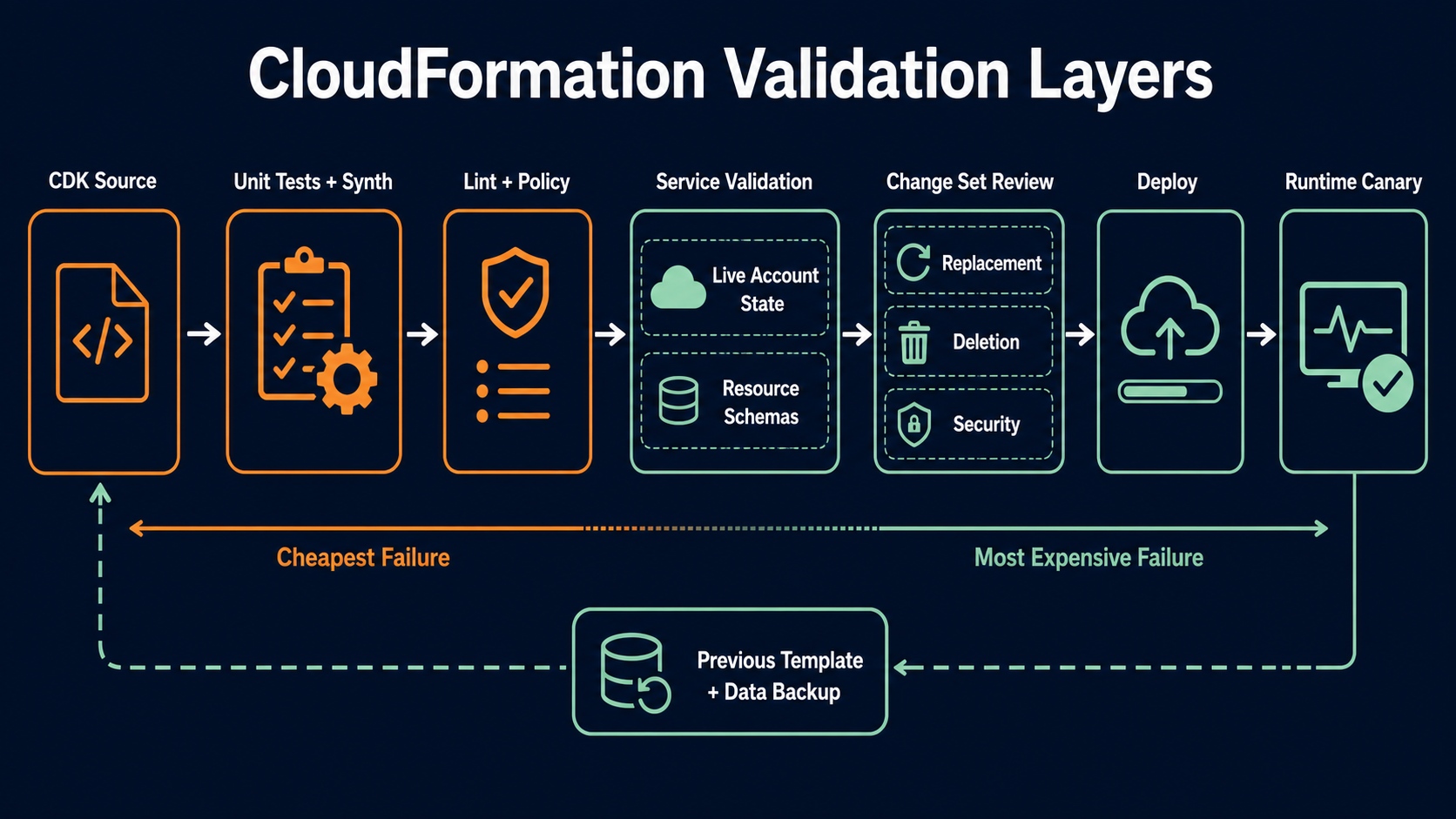
Each layer catches different failures:
format/YAML -> cfn-lint -> CDK synth/test -> policy-as-code
-> CloudFormation pre-deployment validation -> change set review
-> deployment -> readiness and integration tests
| Layer | Fastest useful feedback | Cannot prove |
|---|---|---|
| YAML/JSON parser | File structure | CloudFormation resource semantics |
cfn-lint |
Schema and best-practice errors | Live account conflicts and quotas |
| CDK unit tests | Construct intent and synthesized properties | Target-account state |
| Policy-as-code | Organization security rules | Resource creation success |
| Pre-deployment validation | Known template and account-state conflicts | All runtime behavior |
| Change set | Proposed resource actions | Application readiness |
| Integration canary | Real workload behavior | Every future condition |
Do not remove cfn-lint because CloudFormation validates by default. Local checks return feedback before credentials or an AWS account are needed. Service validation sees live state that local tools cannot.
The OPA and Terraform guardrail guide uses Terraform examples, but its policy separation applies equally to synthesized CloudFormation: compliance rules belong before deployment.
Use cdk validate in pull requests
Update to a CDK CLI version that supports the command, synthesize the target stacks, and validate them against the intended account and Region:
npm ci
npx cdk synth --quiet
npx cdk validate --all
For a multi-environment app, avoid validating every pull request against the production account by default. Use a dedicated validation account with representative quotas and baseline resources, then perform an environment-specific validation during promotion.
cdk validate maps service findings back to construct source where supported. That is much more actionable than a generated logical ID alone. Preserve the report as a CI artifact.
An example GitHub Actions job:
jobs:
  infrastructure-validation:
    permissions:
      id-token: write
      contents: read
    runs-on: ubuntu-latest
    steps:
      - uses: actions/checkout@v4
      - uses: actions/setup-node@v4
        with:
          node-version: 22
          cache: npm
      - run: npm ci
      - run: npm test
      - run: npx cdk synth --quiet
      - run: npx cdk validate --all
Authenticate with OIDC and a narrow validation role. The GitHub Actions OIDC deployment guide shows how to avoid long-lived AWS keys.
Validate raw templates through stack operations
Because validation now runs automatically, ordinary commands gain protection:
aws cloudformation create-stack \
  --stack-name acme-orders-dev \
  --template-body file://template.yaml \
  --capabilities CAPABILITY_NAMED_IAM \
  --client-request-token "pr-4821-attempt-1"
For updates, prefer a change set even though UpdateStack also validates:
aws cloudformation create-change-set \
  --stack-name acme-orders-prod \
  --change-set-name "release-2026-07-30" \
  --change-set-type UPDATE \
  --template-body file://template.yaml \
  --capabilities CAPABILITY_NAMED_IAM

aws cloudformation describe-change-set \
  --stack-name acme-orders-prod \
  --change-set-name "release-2026-07-30"
Do not execute automatically until the change set is created successfully, validation findings are parsed, and organizational policy accepts the warnings.
Turn selected warnings into failures
Create a small policy table:
| Warning | Development | Production |
|---|---|---|
| Service quota would be exceeded | Fail | Fail |
| Config recorder conflict | Fail | Fail |
| Non-empty S3 bucket deletion | Require explicit ephemeral tag | Fail without approved data plan |
| Non-empty ECR repository deletion | Warn for disposable preview repo | Fail without artifact-retention approval |
Parse the validation result and emit a stable policy code, owner, and remediation. Avoid a generic “warning found.” A quota finding belongs to the platform team; a bucket deletion belongs to the data owner.
Use waivers with:
finding: ECR_REPOSITORY_NOT_EMPTY
stack: acme-preview-4821
resource: PreviewRepository
reason: ephemeral pull-request environment
owner: platform-engineering
expires: 2026-08-02T00:00:00Z
ticket: PLAT-991
Expired waivers fail. Production stacks should not inherit preview-environment exceptions.
Use DisableValidation rarely
CloudFormation accepts --disable-validation for an individual create or update:
aws cloudformation update-stack \
  --stack-name acme-emergency \
  --template-body file://template.yaml \
  --disable-validation
AWS documents legitimate cases: another process already validated the template, operation latency is unusually critical, or a known false positive blocks an urgent change. None should become the default deployment alias.
Require an exception record, named approver, exact stack, template digest, expiry, and after-action review. Deny DisableValidation in routine pipeline roles if IAM can distinguish the relevant API condition in your environment; otherwise enforce it in the deployment wrapper and CloudTrail alerting.
Disabling service validation does not disable the need for cfn-lint, policy, change-set, or readiness checks.
Combine validation with Express mode carefully
CloudFormation Express mode can return success after resource configuration is applied instead of waiting for full stabilization. It speeds development and dependent workflows, but the default behavior is still better when “stack complete” must mean “ready to serve.”
aws cloudformation create-stack \
  --stack-name acme-dev \
  --template-body file://template.yaml \
  --deployment-config '{"mode":"EXPRESS"}'

npx cdk deploy --express
Express mode and pre-deployment validation answer different questions:
- Validation: is a known problem visible before provisioning?
- Express mode: when may the deployment command report completion?
The CloudFormation Express mode documentation states that rollback is disabled by default in Express mode unless re-enabled. That is convenient for fast fixes in development and risky as an unexamined production default.
Never use Express mode to hide a slow stabilization failure. Add explicit readiness checks for ECS services, load balancers, CloudFront distributions, databases, or other resources whose control-plane configuration can precede operational readiness.
Test custom resources and hooks separately
CloudFormation cannot predict arbitrary Lambda-backed custom-resource behavior. A template can validate and then fail because the handler times out, returns the wrong response URL, lacks IAM permission, or is not idempotent.
For each custom resource:
- unit-test Create, Update, Delete, retry, and duplicate events;
- bound external calls and total runtime;
- use stable physical resource IDs;
- make deletion safe and idempotent;
- deploy it to a disposable stack in integration tests;
- retain logs and request IDs.
CloudFormation Hooks and policy-as-code can enforce organization rules before provisioning. They complement built-in validation rather than extending its guarantee.
The CloudFormation validation concepts also apply to AI-managed infrastructure: agents may propose a stack operation, but deterministic validation and a reviewed change set still decide whether it can execute.
Review replacements and deletions separately
A template can be perfectly valid and still propose a dangerous replacement. Pre-deployment validation answers whether known failures are visible; it does not decide whether replacing a database, load balancer, or KMS key is acceptable.
Parse every change set into four buckets:
| Change | Default review |
|---|---|
| Add | Quota, cost, IAM, naming, and ownership |
| Modify in place | Service interruption and configuration compatibility |
| Replace | Data migration, endpoint cutover, rollback, and dependent resources |
| Delete | Retention, backup, legal hold, and consumer confirmation |
Fail when a stateful resource has Replacement: True without a named migration approval. Fail when deletion policy changes from Retain or Snapshot to Delete on protected data. Display the physical resource identifier and tags so the reviewer sees what will be affected.
For S3 and ECR warnings, list the objects or image count through a separate read-only job. The built-in warning is an early check; a data owner must decide retention. An empty bucket can still be protected by Object Lock configuration, replication obligations, or an external consumer expecting the name.
Extend the pattern to StackSets and multiple accounts
Account-aware validation can return different results for the same template because quotas, physical names, Config recorders, and existing resources differ. A single tools account is not sufficient evidence for a StackSet targeting hundreds of accounts.
Use waves:
- Validate and deploy to a dedicated canary organizational unit.
- Inspect per-account validation findings and stack events.
- Expand to non-production accounts by Region.
- Deploy a small production wave.
- Continue only while failure and warning rates remain below the stop threshold.
Track results by account and Region. An aggregate “98% succeeded” hides the two accounts where security baselines differ. Set StackSet failure tolerance deliberately and lower than the business’s acceptable drift; maximum concurrency is a blast-radius control, not merely a speed setting.
Use service-managed StackSet permissions where appropriate and keep the validation caller’s account-read permissions separate from execution roles. A central role does not need permanent broad read access to every resource type if validation is scoped through a deployment service and target-account role.
Validate imports and refactors
Moving existing resources under CloudFormation control is a high-risk operation even when no new resource is created. Resource import requires exact identifiers and a template that represents the current resource. Validate the template, generate an import change set, and run drift detection immediately after import.
Do not combine a large import with property changes. First import the resource in its current configuration. Confirm IN_SYNC. Then make one reviewed change in a later operation. This separates ownership transition from behavioral change.
When refactoring CDK constructs, compare synthesized logical IDs. Renaming a construct path can cause CloudFormation to see delete-and-create rather than a harmless code move. Use CDK refactoring support where applicable or override logical IDs carefully. The service validator may accept both resources even though the change set reveals a replacement.
The EKS zero-downtime upgrade playbook demonstrates the same safe pattern at another layer: separate control-plane correctness from workload readiness and preserve a measured rollback path.
Add drift and readiness after deployment
CloudFormation success proves the stack operation reached its completion criteria. Configuration can drift later through console edits, service automation, or incident response. Schedule drift detection for high-value stacks and route findings to the resource owner.
Post-deployment canaries should validate the workload contract:
DNS resolution -> TLS handshake -> authentication -> one read transaction
-> one reversible write in a canary tenant -> telemetry and alarm presence
Express-mode deployments require these checks even more because stack completion can precede full stabilization. Keep the previous template, parameter set, asset digests, and application version together. A rollback with the old template but new container tag is not a rollback.
Track validation duration, findings by type, failures prevented before provisioning, waivers, runtime deployment failures after a clean validation, and drift. The last metric reveals gaps: if many deployments pass validation and then fail on the same custom resource, add a local or hook-based check earlier.
Diagnose validation failures quickly
Create and update operations return an operation ID. Use stack events to retrieve findings:
aws cloudformation describe-stack-events \
  --stack-name acme-orders-dev \
  --max-items 50
For change sets, inspect Status, StatusReason, and validation details before assuming a template syntax error.
| Failure | First check |
|---|---|
| Property type or unsupported field | Synthesized template and resource schema |
| Resource already exists | Physical name, account/Region, import or generated name |
| Quota warning missing | Validation-role read permissions |
| Bucket/repository warning | Correct target account and deletion action in change set |
| Local pass, service fail | Live-state conflict or newer service schema |
| Service pass, deploy fail | Runtime dependency, IAM, hook, custom resource, stabilization |
Do not automatically retry a deterministic validation failure. Retries waste time and can hide noisy pipelines. Retry only transient service errors with a bounded count.
Production gate checklist
| Gate | Evidence |
|---|---|
| Source | Reviewed CDK/template and dependency lockfile |
| Local | Format, tests, cfn-lint, synth |
| Security | Policy-as-code and IAM review |
| Service | Pre-deployment validation report with no unapproved findings |
| Change | Change set and replacement/deletion review |
| Recovery | Rollback trigger, data backup, previous template digest |
| Runtime | Post-deploy readiness and application canary |
Measure whether validation is paying for itself
Track failures by the stage that first detected them: local syntax, linting, policy, service validation, change-set review, deployment, or runtime. Also record the failed resource type and whether the finding was actionable. Over several releases, this shows whether the new gate is moving expensive failures earlier or merely adding another green check.
Useful outcome metrics include deployment failures per hundred stack operations, median time from failed validation to corrected commit, replacement or deletion findings caught before approval, and false-positive exceptions by rule. Do not reward the platform team for the number of validations executed. Reward fewer late failures and faster, safer recovery.
Review the distribution quarterly. If the same resource error still reaches deployment, add a local or policy rule when feasible. If a validation warning is waived repeatedly for the same accepted architecture, codify the exception narrowly with an owner and expiration. The pipeline should learn from production evidence without turning every one-off failure into a permanent organization-wide prohibition.
The most valuable change is automatic coverage on direct create and update operations. It closes a gap for teams that skipped change sets. Mature production pipelines should still use change sets because preview, approval, and deletion review remain essential.
Pre-deployment validation moves failure earlier. Keep the layers around it. The goal is not a stack that passes validation; it is a change whose intent, account state, security, resource operations, and runtime behavior have all been checked at the cheapest responsible stage.
Sources
Explore more like this

Cloud IoT Security: Zero Trust, Identity, and Signed Updates
On September 11, 2026, the Cyber Resilience Act’s incident-reporting rules start applying in the European Union. That is 22 days after this article’s publication date. A manufacturer that learns of...

Kill the Docker Hub Token: OIDC Trust for GitHub Actions
On July 31, 2026, Docker shipped OIDC connections for GitHub Actions to any organization on a Docker Team, Docker Business, or Docker Hardened Images subscription, plus organizations in the Docker-Sponsored...

Bedrock Web Search: Grounding an Agent Without Building a Scraper
On August 4, 2026, AWS made Web Search on Amazon Bedrock generally available, and the entire integration surface is one JSON object: {"type": "web_search"}. That is the whole change from...

Comments