
CloudFront Cache Tag Invalidation: Precise Purges Without Nuking Your Cache

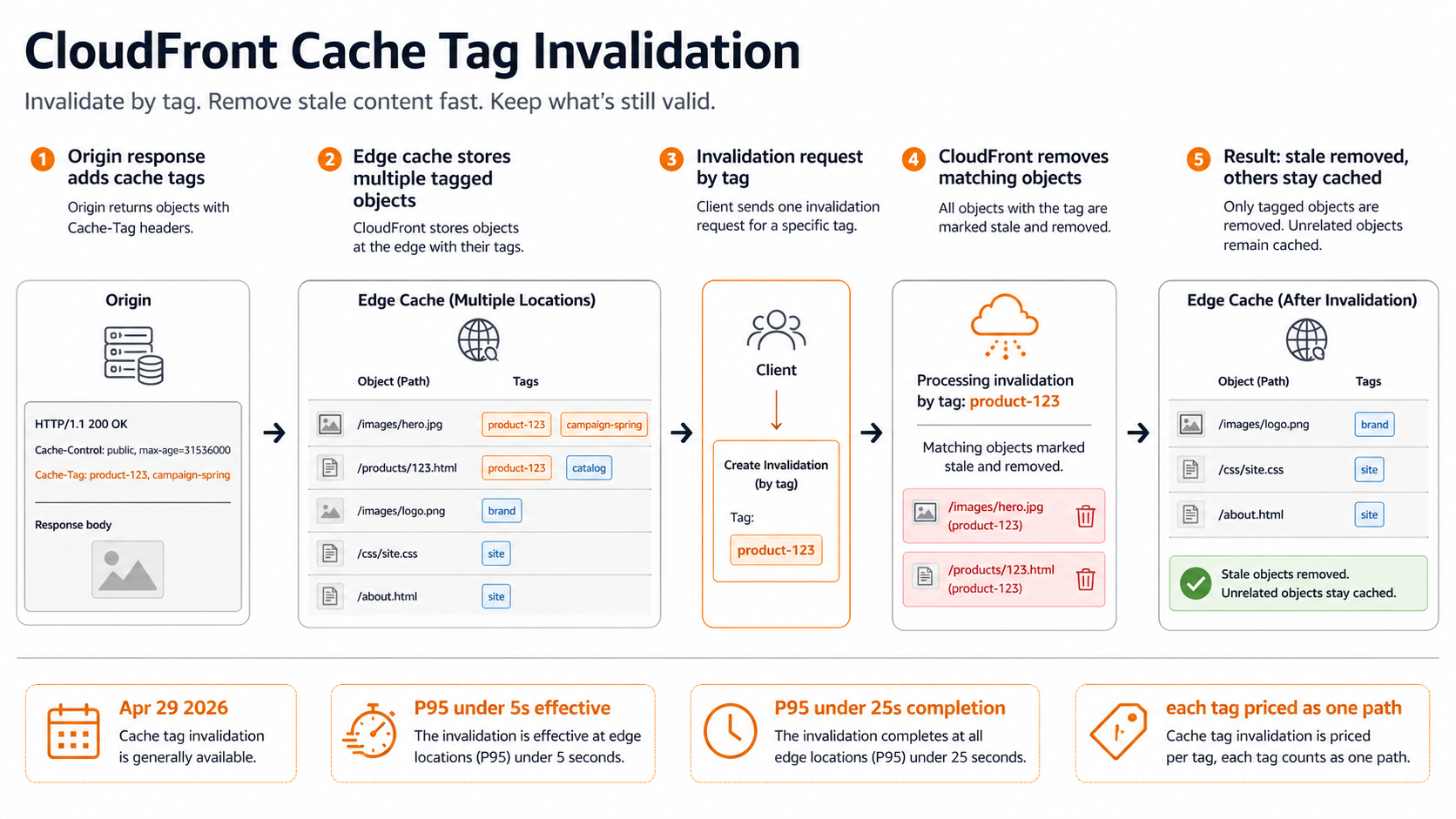
On April 29, 2026, CloudFront got a feature I have wanted for years: native cache invalidation by tag. AWS says tag invalidations become effective in under 5 seconds at P95 and complete in under 25 seconds at P95. That is a very different tool from the old “invalidate /* and hope the origin survives” habit.
The value is precision. A product page, a tenant logo, a documentation section, or a legal takedown can now map to a cache tag. When that thing changes, you invalidate the tag and leave unrelated cached objects alone. For teams already using CloudFront with S3, ALB, WAF, or custom origins, this is a small config change with a big operational payoff.
What Changed
The old CloudFront invalidation model made paths the unit of purge. That worked for simple static sites, but it became awkward once one business object produced many URLs. Think /products/123, /api/products/123, /search?q=123, resized images, localized pages, and metadata endpoints. You either listed every path or used a wildcard that evicted far more cache than necessary.
Cache tags flip that model. Your origin attaches a response header with one or more tags. CloudFront remembers the relationship between cached objects and tags. Later, an invalidation request targets the tag, not the URL list. The unrelated objects stay cached, which means fewer origin spikes and less accidental cache churn.
This belongs next to your deployment workflow, not only in a break-glass runbook. If your application can identify what changed, it can emit the right tag and invalidate only that slice of the cache.
The Numbers That Matter
| Fact | Number or date | Source |
|---|---|---|
| Launch date | April 29, 2026 | AWS What’s New |
| Effective time | under 5 seconds at P95 | AWS What’s New |
| Completion time | under 25 seconds at P95 | AWS What’s New |
| Pricing model | each cache tag invalidation is priced as one path | AWS What’s New / pricing |
| Availability | all CloudFront regions except AWS China regions | AWS What’s New |
Those facts are the reason this post should be published now, not next quarter. The dates are fresh, the limits are concrete, and the operational impact is clear enough for an engineer to act on today.
How It Works in Practice
Start by designing tags around business invalidation events. product:123 is usually better than url:/products/123 because the same product can appear in many places. tenant:acme works when customer branding changes across multiple pages. doc:eks-rbac works when one content node feeds web pages, API responses, and search fragments.
Keep the tag vocabulary boring. Lowercase strings, stable IDs, and a small prefix set beat clever generated names. The tag is now part of your cache-control contract, so treat it like an API. Document who owns it, how long it lives, and what event invalidates it.
For static sites, this changes the conversation in S3 static website hosting behind a CDN. You can still deploy immutable file names for assets, but cache tags give you a cleaner way to purge collections of HTML or JSON without hammering the whole distribution.
HTTP/1.1 200 OK
Cache-Control: public, max-age=3600
CloudFront-Cache-Tag: product:123,tenant:acme,catalog:winter
Content-Type: text/html; charset=utf-8
The exact header name is configurable. Pick one name and make every origin behind the distribution use it consistently. Then wire invalidation into the same event that changes the object, such as a CMS publish event, catalog import, or tenant-branding update.
Gotchas I Would Check First
- Do not tag every response with a unique request ID. That destroys the point of grouping cached objects.
- A tag invalidation still has a cost model. AWS says each cache tag invalidation is priced as one path, so noisy invalidation loops can still waste money.
- CloudFront will only know about tags that are present when the object is cached. Deploy the header first, let objects refill, then depend on tag purges.
Decision Guide
| Scenario | Use cache tags? | Why |
|---|---|---|
| One object appears under many URLs | Yes | Tag invalidation removes every representation together |
| Static fingerprinted assets | Usually no | Immutable file names already solve this cleanly |
| Emergency global rollback | Maybe | A wildcard can still be simpler during a broad incident |
| Multi-tenant branding | Yes | A tenant tag is cleaner than tracking every logo and page URL |
For related background, keep these existing BitsLovers posts close: CloudFront versus Global Accelerator tradeoffs, CloudFront fundamentals, AWS WAF rules in front of CloudFront, S3 static website hosting behind a CDN.
Sources
The best CloudFront purge is the one that does not empty the cache you still need. Cache tags finally make that pattern native.
Explore more like this

Cloud IoT Security: Zero Trust, Identity, and Signed Updates
On September 11, 2026, the Cyber Resilience Act’s incident-reporting rules start applying in the European Union. That is 22 days after this article’s publication date. A manufacturer that learns of...

Kill the Docker Hub Token: OIDC Trust for GitHub Actions
On July 31, 2026, Docker shipped OIDC connections for GitHub Actions to any organization on a Docker Team, Docker Business, or Docker Hardened Images subscription, plus organizations in the Docker-Sponsored...

Bedrock Web Search: Grounding an Agent Without Building a Scraper
On August 4, 2026, AWS made Web Search on Amazon Bedrock generally available, and the entire integration surface is one JSON object: {"type": "web_search"}. That is the whole change from...

Comments