
GitLab Runner Tags – Complete Guide for Complex Scenarios

Article updated on April 2026.
What are GitLab Runner Tags?
Tags are labels you assign to a runner so you can identify it and control which jobs it picks up. If you have more than one runner registered (which is common), tags are how you tell GitLab CI which runner should handle which job.
Why do you need tags?
A GitLab Runner is a separate application that executes CI/CD jobs. You can install it on different operating systems, cloud instances, or virtual machines. Since different projects have different requirements (OS, hardware, cloud account), you need a way to route jobs to the right runner. That is what tags do.
Multiple runners for different AWS accounts
If you deploy runners on AWS EC2 instances, you probably have separate AWS accounts for Dev, QA, and Production. Each account needs its own runner, and each runner should only have permissions for its own account. Tags let you make sure a production deploy job only runs on the production runner, and a dev job only runs on the dev runner.
This matters because deploy scripts often have broad access to your AWS resources. Without tags, you risk a CI job in one environment accidentally hitting resources in another.
When to use tags
Heavy pipelines vs. lightweight projects
Some pipelines need a lot of CPU or memory. It is a good idea to keep those on dedicated runners rather than sharing with smaller projects. If a heavy build hogs a shared runner, everyone else waits.
We covered this in our post about configuring a Runner using AWS Fargate, where we used Fargate for heavy pipelines and a regular runner for everything else. Fargate takes a couple of minutes to spin up an executor, so it is a poor fit for quick jobs that finish in under two minutes. Tags let you route each pipeline to the right infrastructure.
A runner can have multiple tags, or none at all
Tags are optional. You can assign zero tags, one tag, or several tags to a single runner. A runner with no tags can pick up untagged jobs (depending on its run_untagged setting).
Who can configure tags?
Only GitLab administrators can assign tags to shared runners. Project maintainers can configure tags on project-specific runners.
How to configure GitLab Runner Tags
There are two ways to set up tags: during runner creation (the recommended approach), or later through the GitLab admin UI.
Creating a runner with tags (current method)
GitLab introduced a new runner creation workflow starting in version 15.10. The old --registration-token method is deprecated and scheduled for removal in GitLab 20.0. Here is how it works now.
First, create the runner in the GitLab UI:
- Go to Settings > CI/CD > Runners
- Click New runner
- Choose the platform, add your tags, and set the
run_untaggedoption - Click Create runner and copy the authentication token (it starts with
glrt-)
Then register it on your machine:
gitlab-runner register \
  --non-interactive \
  --url "https://gitlab.example.com/" \
  --token "glrt-xxxxx-YOUR-AUTH-TOKEN" \
  --executor "docker" \
  --docker-image alpine:latest
Notice that the new method uses --token with an authentication token. Tags are set in the UI when you create the runner, not on the command line.
The legacy method (deprecated)
For reference, here is the old approach. This still works on older GitLab versions but will stop working in a future release:
sudo gitlab-runner register \
  --url "https://gitlab.example.com/" \
  --registration-token "THE_REGISTRATION_TOKEN" \
  --executor "docker" \
  --docker-image alpine:latest \
  --description "docker-runner" \
  --tag-list "docker,aws" \
  --run-untagged="true" \
  --locked="false"
The --tag-list parameter let you specify tags at registration time. The --run-untagged flag controlled whether the runner would pick up jobs that did not specify any tag. If you set --run-untagged="false", the runner only picked up jobs that explicitly matched its tags.
If you are still using --registration-token, migrate to the new workflow as soon as possible. The old registration tokens are long-lived shared secrets, which is a security risk. The new tokens are unique per runner and can be revoked individually.
Editing tags in the GitLab UI
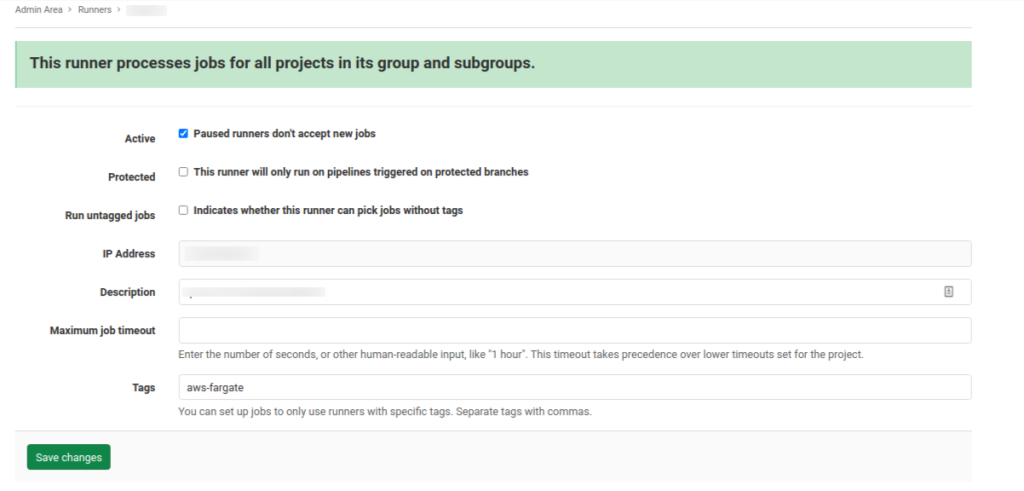
You can also change tags after a runner is created. Navigate to the Settings > CI/CD > Runners section, select your runner, and edit the configuration:
How to use tags in your pipeline
Run jobs on different platforms
If you have a Windows runner tagged windows and a macOS runner tagged macos, you can target each one:
windows_job:
  stage: build
  tags:
    - windows
  script:
    - echo "Running on Windows"

macos_job:
  stage: build
  tags:
    - macos
  script:
    - echo "Running on macOS"
Or if you have a Fargate runner tagged aws-fargate:
build:
  stage: build
  tags:
    - aws-fargate
  script:
    - ./configure && make && make install
Use variables for dynamic tag selection
You can also use CI/CD variables instead of hardcoding tag values:
variables:
  TAG_RUNNER: "aws-fargate"

job:
  tags:
    - linux-large
    - $TAG_RUNNER
  script:
    - echo "Building the project"
This is handy when you want to change the target runner based on the branch or some other condition. You can set TAG_RUNNER in the GitLab UI under Settings > CI/CD > Variables, or override it per pipeline.
Wrapping up
Tags give you control over how jobs get routed to runners. They are essential when you have multiple runners across different environments, operating systems, or cloud accounts. If you are running anything beyond a single shared runner, you will need them.
Related articles
- GitLab Runner Tags: Complete Guide for 2026 — updated guide covering Kubernetes executor patterns, protected runners, and tag strategies for multi-environment pipelines
- How to use GitLab CI Variables
- Effective Cache Management with Maven Projects on GitLab
- Build Docker in Docker on GitLab CI
- Execute Terraform on GitLab CI
- Deploy to Elastic Beanstalk from GitLab CI
- GitLab CI Parallel Matrix for Monorepos — run jobs across multiple modules in parallel using matrix builds
- Migrate Jenkins to GitLab CI — step-by-step guide for teams moving from Jenkins pipelines to GitLab CI
- GitLab CI Environments and Review Apps — manage environment-specific deployments and spin up review apps per branch
Explore more like this

Kill the Docker Hub Token: OIDC Trust for GitHub Actions
On July 31, 2026, Docker shipped OIDC connections for GitHub Actions to any organization on a Docker Team, Docker Business, or Docker Hardened Images subscription, plus organizations in the Docker-Sponsored...

Lambda SQS Provisioned Mode Now Scales to 10,000 Pollers: The Throughput Math That Decides If You Need It
AWS raised the poller ceiling on August 3, 2026. Provisioned Mode for Amazon SQS event source mappings went from a maximum of 2,000 event pollers to 10,000, which puts the...

CloudWatch Managed Prometheus Collectors on EKS: Delete the Scraper, Keep the Metrics
On July 31, 2026, AWS shipped managed Prometheus collectors for Amazon CloudWatch. The pitch is short: you hand CloudWatch a scrape configuration and a VPC connection, and AWS provisions, scales,...

Comments