
Responsible AI GRC on AWS: Bedrock Agent Controls for Financial Services

AWS updated its responsible AI governance, risk, and compliance guidance for financial services on May 13, 2026. The useful part is not another principles list. The useful part is turning those principles into controls a platform team can actually operate.
That is why this post is intentionally practical. It does not try to turn Responsible AI GRC on AWS into a product brochure. It treats the announcement, release, or vulnerability as an operating decision: what should a cloud team change, what can wait, what has to be measured, and which guardrails keep the fix from becoming a new source of downtime.
If you are connecting this to the existing BitsLovers library, start with Bedrock trust and safety checklist, Bedrock IAM cost allocation, Security Hub and CloudWatch findings, IAM Identity Center ABAC, OpenAI on Amazon Bedrock, SageMaker capacity-aware inference. Those articles cover the adjacent platform patterns; this one focuses on governance, risk, and compliance controls for Bedrock agents and AI systems in regulated environments.
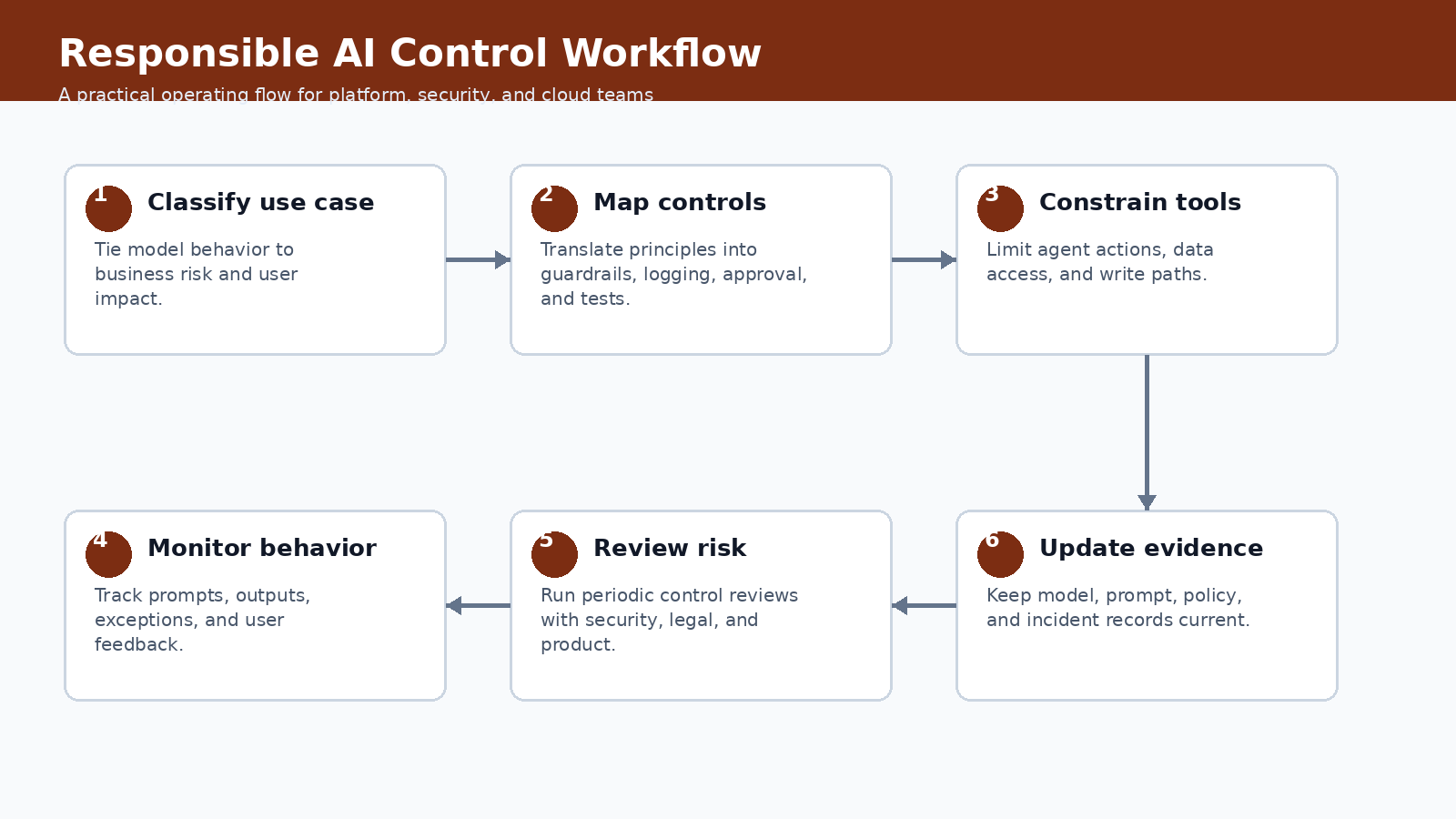
The workflow above is the recommended operating model. It keeps the discussion out of the abstract. You start with the signal, scope the blast radius, implement the smallest useful control, verify the result, and then turn the work into a repeatable runbook. That order matters. A lot of teams jump straight from announcement to tooling. That feels fast, but it usually skips ownership, rollback, and the boring evidence an auditor or incident reviewer will ask for later.
What Changed
The updated AWS guide gives financial-services teams a responsible AI framing across governance, risk, and compliance. That matters for Bedrock agents because agents do not just generate text. They can call tools, retrieve data, trigger workflows, and influence decisions. That moves responsible AI from a policy document into architecture.
The date matters here because engineering teams already have plenty of stale guidance in their wikis. Treat this as a May 2026 operating note. If a vendor updates the documentation later, update the runbook and leave a revision note in the post. That is not editorial polish; it is how you keep technical content from becoming another unsafe copy-paste source.
A Bedrock agent control model has several layers: model selection, guardrails, prompt and tool design, identity boundaries, data access, logging, human approval, output evaluation, and incident response. The GRC work is mapping each layer to a control owner and evidence source.
Why Platform Teams Should Care
Regulated teams cannot ship AI systems on vibes. They need to answer who approved the use case, what data the model can see, what actions the agent can take, how harmful outputs are blocked, how drift is detected, and how incidents are handled. If the answer lives only in a slide deck, it will not survive production.
This is also where cost and reliability get mixed together. A feature that looks like a security improvement can increase build time, data scanned, node churn, or operational review effort. A reliability feature can quietly move risk from the service team to the platform team. A new AI workflow can shorten analysis time and still create a governance problem if the identity model is weak. Good engineering writing should name that tradeoff.
For Responsible AI GRC on AWS, the practical question is not “is this useful?” It is useful. The better question is where the control should live. If it belongs in a one-off project, document it there. If it belongs in the platform baseline, put it in CI, admission control, IAM, observability, or a shared runbook. Most teams get into trouble when they make that boundary implicit.
Operating Baseline
The baseline is an AI system inventory. Each use case should have a business owner, data classification, model provider, allowed tools, user population, approval state, monitoring plan, and rollback path. Without that inventory, GRC becomes a meeting series instead of an operating system.
| AI use case | Control depth | Reason |
|---|---|---|
| Internal summarization | Moderate | Low action risk but data exposure matters |
| Customer-facing advisor | High | User harm and compliance risk are direct |
| Agent with write tools | Very high | Model output can trigger real action |
| Sandbox prototype | Low to moderate | Constrain data and disable production tools |
The table is deliberately opinionated. It gives you a default answer before the exception shows up. Exceptions are fine; hidden exceptions are not. If someone wants to bypass the default, require a reason, an owner, and an expiration date. That one small rule prevents a lot of permanent “temporary” infrastructure.
Implementation Pattern
A useful control file should be boring enough for audit and precise enough for engineers.
ai_control_record:
  use_case: claims-assistant
  owner: financial-products
  data_classification: confidential
  model_family: amazon-bedrock-approved
  tools_allowed:
    - read_policy_documents
    - create_case_summary
  tools_denied:
    - approve_claim
    - modify_customer_record
  guardrails_required: true
  human_approval_required_for: [external_response, policy_exception]
  logs_retention_days: 365
The snippet is not meant to be pasted blindly. Use it as the shape of the implementation, then adapt names, account boundaries, tags, and approval gates to your environment. The useful part is the sequence: inspect, constrain, verify, and record evidence. If your process cannot produce evidence, it is not mature enough for production.
Controls, Metrics, And Evidence
Responsible AI metrics should connect model behavior to business risk.
| Control | Evidence | Review cadence |
|---|---|---|
| Use-case approval | Signed control record and owner | Before launch and quarterly |
| Guardrail coverage | Guardrail config and test results | Per prompt or tool change |
| Tool boundary | IAM policy and agent action list | Per release |
| Incident response | Escalation path and sample drill | Twice per year |
Notice that the table separates a control from the evidence. A control without evidence is a hope. Evidence without an owner is a screenshot in a ticket that nobody trusts three months later. Tie each signal to a system that already has retention, access control, and review habits.
Rollout Plan
Roll out responsible AI controls like product controls, not like a compliance memo.
- Create an AI use-case register before adding more agents.
- Classify each use case by user harm, data sensitivity, and action authority.
- Require tool allowlists and deny write actions by default.
- Run red-team prompts against every high-risk workflow and keep the results.
- Review logs and user feedback with security, legal, and product owners on a fixed cadence.
This is where teams often overbuild. Start with the smallest production slice that proves the behavior. One non-critical cluster, one runner group, one application namespace, one account, or one data domain is enough. Then widen the blast radius only after you have a rollback path and a metric that proves the change did not make the system worse.
Gotchas
Responsible AI programs fail when controls are too abstract.
- A principle like fairness needs a testable decision point. Otherwise nobody knows what passed.
- Guardrails do not replace data-access controls. The model should not receive data it is not allowed to use.
- Agents with tools need stronger review than chat-only systems. Action authority changes risk.
- Human approval must be placed before the risky action, not after a customer-impacting mistake.
- Evidence retention needs a policy. Keeping every prompt forever can create privacy and legal problems.
The uncomfortable lesson is simple: new platform features usually fail at the handoff points. The vendor feature works. The identity mapping is incomplete. The backup restores but not the secret. The scanner finds an issue but nobody owns the fix. The autoscaler drains a zone correctly but the application has a bad disruption budget. These are not edge cases. They are where production work lives.
Security, Reliability, And Cost Tradeoffs
The compliance gain is stronger accountability. The product cost is slower launch for high-risk use cases. That is appropriate. Low-risk internal helpers can move faster, but agents that touch customers, money, identity, or regulated advice need a heavier gate.
Use a scorecard before rolling the pattern to every team:
| Question | Good answer | Weak answer |
|---|---|---|
| Can we name the owner? | Business, technical, and risk owners are listed | AI platform owns everything |
| Can we prove constraints? | Guardrails, IAM, and tool allowlists are tested | Prompt says be careful |
| Can we respond to harm? | Incident path and rollback exist | Team would improvise |
The weak answers are not moral failures. They are just not production answers yet. If your current state is weak, write the gap down, choose the next smallest fix, and keep the change contained until the evidence improves.
First 48 Hours In Practice
The first two days decide whether Responsible AI GRC on AWS becomes a controlled platform improvement or another half-finished note in a chat thread. I would split the work into three windows: the first hour, the first business day, and the first week. The first hour is about scope. Do not change production yet unless the exposure is obvious. Name the owner, capture the source link, list affected systems, and decide whether this is emergency work or scheduled platform work.
By the end of the first business day, the team should have one working example. That could be one patched runner pool, one restored namespace, one repository review, one governed data domain, one EKS node group, or one shared VPC deployment. The exact target depends on the topic. The point is to choose a small production-shaped slice, not a toy. A lab that has no secrets, no real users, no deployment pressure, and no monitoring will hide the problems that matter.
The first-week goal is repeatability. If the change worked once because a senior engineer babysat it, you have a useful experiment, not a platform pattern. Turn the successful path into a runbook with commands, screenshots, expected output, rollback steps, and escalation rules. Then test it with someone who did not write the first version. That review will expose missing assumptions faster than another hour of polishing.
For governance, risk, and compliance controls for Bedrock agents and AI systems in regulated environments, the review meeting should be short and concrete. Ask what changed, which systems are in scope, which systems are intentionally out of scope, what evidence proves the control works, and what would make the team roll back. If the group cannot answer those five questions, the change is not ready to become a default.
| Owner | Decision to make | Evidence they should demand |
|---|---|---|
| Service owner | Confirms scope and business impact | Accepts or rejects the default action for Internal summarization |
| Platform owner | Turns the pattern into a shared control | Publishes the runbook, dashboard, and rollback path for Responsible AI GRC on AWS |
| Security owner | Reviews risk and exception handling | Checks that Use-case approval has usable evidence |
| FinOps or operations owner | Checks cost and toil | Watches whether Guardrail coverage creates recurring work |
One practical habit helps a lot: write the rollback criteria before the rollout starts. For Responsible AI GRC on AWS, a rollback may mean re-enabling an old runner path, restoring a prior IAM policy, pausing an agent workflow, undoing an autoscaling setting, or reverting to a previous storage ownership model. Whatever the answer is, write it down. Operators make better decisions during incidents when the stop condition is already named.
Runbook Artifacts To Keep
A trustworthy runbook is not a wall of prose. It is a small set of artifacts that prove the system can be operated by more than one person. Keep the procedure, the evidence, and the exception list separate. Procedures change often. Evidence grows during exercises and incidents. Exceptions need owners and expiration dates because otherwise they become the real architecture.
| Artifact | What good looks like | Maintenance rule |
|---|---|---|
| Runbook page | One current procedure with commands, owners, and rollback | Update after every exercise or incident |
| Evidence folder | Screenshots, command output, logs, ticket IDs, and query results | Keep according to audit and incident policy |
| Exception register | Every skipped service, account, cluster, repo, or dataset | Owner plus expiration date required |
| Dashboard link | The live view operators use during rollout | Must show the metric in the control table |
The evidence should be boring enough to survive an audit and specific enough to help an engineer at 2 a.m. A command transcript showing signed control record and owner is useful. A dashboard screenshot with no time range is not. A ticket that says “verified” is weak. A ticket with the exact source, system, output, owner, and next review date is much stronger.
This also keeps trust resources honest. A blog post can point to AWS, Kubernetes, GitLab, or project documentation, but the local runbook has to say how your team interpreted that source. If the official document changes, the local procedure needs a review. If the source disappears, the team needs a replacement. That is why the trusted resources section at the end of this post is not decorative; it is part of the operating model.
Example Review Questions
Use these questions before making Responsible AI GRC on AWS a default pattern:
- What is the smallest system where we proved this works with production-like constraints?
- Which team owns the control after the initial rollout is finished?
- Which metric tells us the change helped instead of simply adding process?
- What is the first rollback action if a principle like fairness needs a testable decision point. otherwise nobody knows what passed.?
- What exception would we approve, and how long may that exception live?
- Which trusted source would force us to revisit the design if it changed?
Two questions deserve blunt answers. First, does the pattern reduce risk, or does it only move risk to another team? Second, can a new engineer follow the runbook without private context? If the answer to either question is no, keep the rollout narrow.
A Concrete Failure Scenario
Imagine the team accepts the default action for internal summarization but ignores customer-facing advisor. At first, the rollout looks successful. The dashboard turns green. The announcement is written. Then the first exception arrives. A service owner cannot meet the deadline, a cluster has an unusual constraint, or a repository breaks in a way the shared workflow did not predict. Without an exception register, the team handles that case in a side conversation. Two weeks later nobody remembers whether the exception was temporary.
That is the failure mode this article is trying to avoid. The technology can be good and the rollout can still decay. The fix is not more meetings. The fix is a small operating loop: define the default, record the exception, attach an owner, set an expiration date, and review the evidence. This is simple, but it is not optional for production work.
Guardrails do not replace data-access controls. The model should not receive data it is not allowed to use. That gotcha should shape the rollout. Put it in the runbook as a check, not as a footnote. If a future operator has to rediscover it during an outage or audit review, the article failed to become operational knowledge.
When To Use This
Use this pattern when AI systems touch regulated data, customer decisions, financial workflows, or tools that can change records.
Do not use it when the use case is a private prototype with synthetic data and no access to production systems. That boundary is important because the wrong abstraction can make a simple system harder to operate. Sometimes the best platform decision is to leave a feature out of the shared baseline and document a local exception instead.
Trusted Resources
These are the sources I would keep next to the runbook:
- AWS Security Blog responsible AI GRC guide
- AWS Responsible AI
- Amazon Bedrock Guardrails
- Amazon Bedrock Agents
- NIST AI Risk Management Framework
- SageMaker Model Monitor
I am intentionally marking one uncertainty: regulatory expectations and AWS service capabilities can change, so legal and compliance owners must review controls for the actual jurisdiction. Treat the article as an operating guide, not as a replacement for the vendor documentation. The source links above are the authority when a limit, feature state, or mitigation changes.
The Practical Takeaway
Responsible AI is not a values poster. For Bedrock agents, it is a set of tool limits, logs, tests, owners, and evidence.
Explore more like this

Cloud IoT Security: Zero Trust, Identity, and Signed Updates
On September 11, 2026, the Cyber Resilience Act’s incident-reporting rules start applying in the European Union. That is 22 days after this article’s publication date. A manufacturer that learns of...

Kill the Docker Hub Token: OIDC Trust for GitHub Actions
On July 31, 2026, Docker shipped OIDC connections for GitHub Actions to any organization on a Docker Team, Docker Business, or Docker Hardened Images subscription, plus organizations in the Docker-Sponsored...

Bedrock Web Search: Grounding an Agent Without Building a Scraper
On August 4, 2026, AWS made Web Search on Amazon Bedrock generally available, and the entire integration surface is one JSON object: {"type": "web_search"}. That is the whole change from...

Comments